
Dostoyevsky in Ireland
An Essay
Every evening in the west, Eurasian skylarks sing berserkly and dart across the gray-blue stretched wide over bog and rock, over sheep and cows and ponies, and a smattering of houses and their people. Down the road are protected nesting grounds for the northern lapwing, Ireland’s national bird. By the end of this trip we’ll have seen a handful of lapwings as well as European robins, Eurasian wrens, barn swallows, magpies, jackdaws, hooded crows, sand martins, meadow pipits, terns, gulls, wagtails, whinchats, a northern wheatear, a Eurasian oystercatcher, and a million house sparrows.
In the hours before dusk we walk up a narrow road, traversed mostly by farmers’ trucks and ATVs, and cross over into the unruly seaside hills, weave through copses of slender thistle, gather sticks and peer at tufts of radiant wildflowers. The air is pure: breathing in does not feel like a compromise. Back in the rental cottage we eat a simple meal and listen to Irish public radio. The sun will not set until near 9 p.m. It is April.
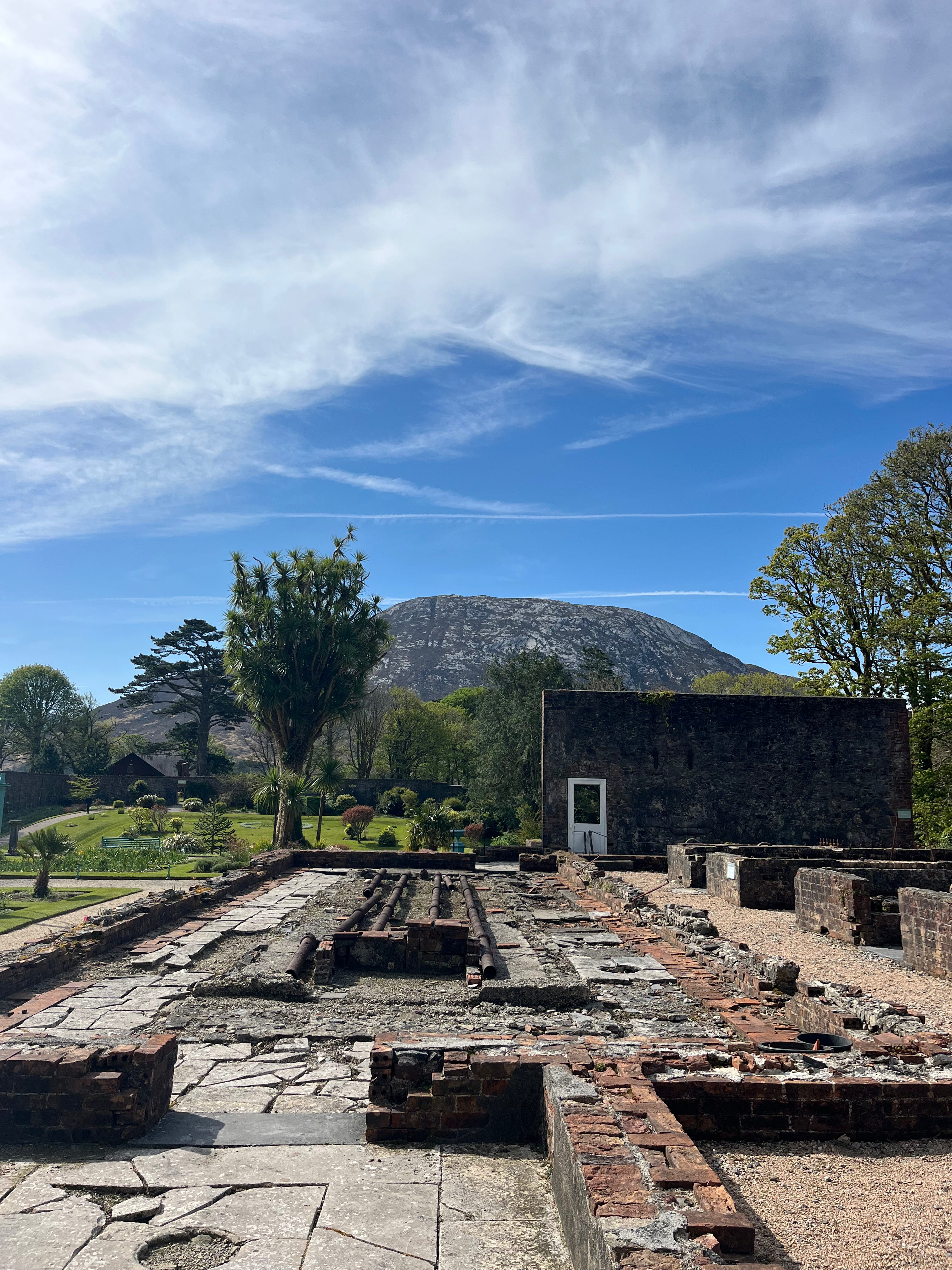
We wake up early, eat, bathe, dress. We drive down serpentine roads to the nearest town and a national park. We climb a mountain. We visit its neighbor, a Benedictine abbey. The nuns make honey, jam, chocolate, and soap. They tend the gardens and hold daily services. Work and Pray: a life in totality.
A week ago we went on a boat tour in Howth harbor, trying to get a closer look at Ireland’s Eye and what remains of a chapel built in the 8th century and maintained by monks for over 500 years. Upon castoff the chief engineer explained to his passengers that it would likely be too dangerous that day to circle the island, and that we’d go only so far as he deemed safe. Then he crossed himself, held his hands up, and said, “You’re with God.”
I wonder over this relaxed gesture of renunciation. The way the man’s competence was not diminished by his willingness to acknowledge the limitations of his power. No anxiety. Whereas it almost always seems to me that it’s my duty and mine alone to make sure the sky doesn’t fall.
I’ve brought three books: Notes from Underground and Crime and Punishment by Dostoyevsky, and Dostoyevsky Reads Hegel in Siberia and Bursts Into Tears by László Földényi. Weeks ago I read Mrs. Dalloway for the first time and thereafter learned, almost by accident, that Virginia Woolf considered Dostoyevsky to be the greatest writer to have ever lived. “To be overly conscious is a sickness,” Dostoyevsky writes in the first pages of Notes from Underground. This may be the only statement in the whole book that I come close to comprehending. When I’ve finished it, I read László’s essay. It is difficult and exciting. Woolf said a good work of literature should be difficult: it’s meant to make the mind work.
I underline: “Never has humanity been so satisfied with its own self—like a spoiled and careless child, left to itself, allowed to do whatever it wishes. But that same child, when evening descends, having no idea of what to do with its freedom and fearful, is suddenly filled with anguish.”
And: “We have murdered God with our ambition…And it is none other than our drive to find an answer for everything. When we began to seek solutions for things for which there are clearly no solutions, this ambition became transformed into hubris. In other words, it occurred when even transcendence itself turned into a practical question.”
And: “When the entirety of existence, the cosmic whole is reduced to a world that can be technically manipulated—this is hell.”
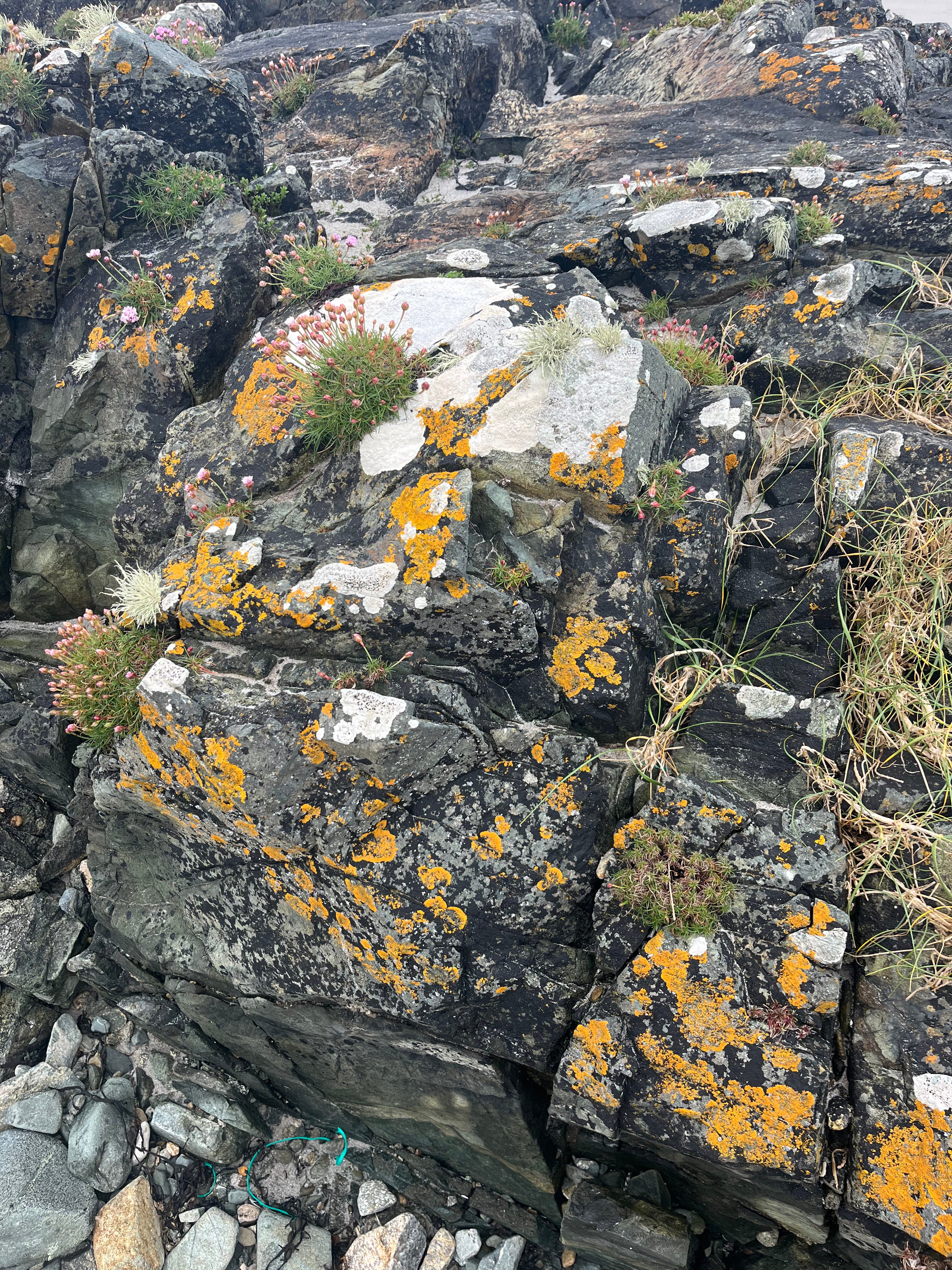
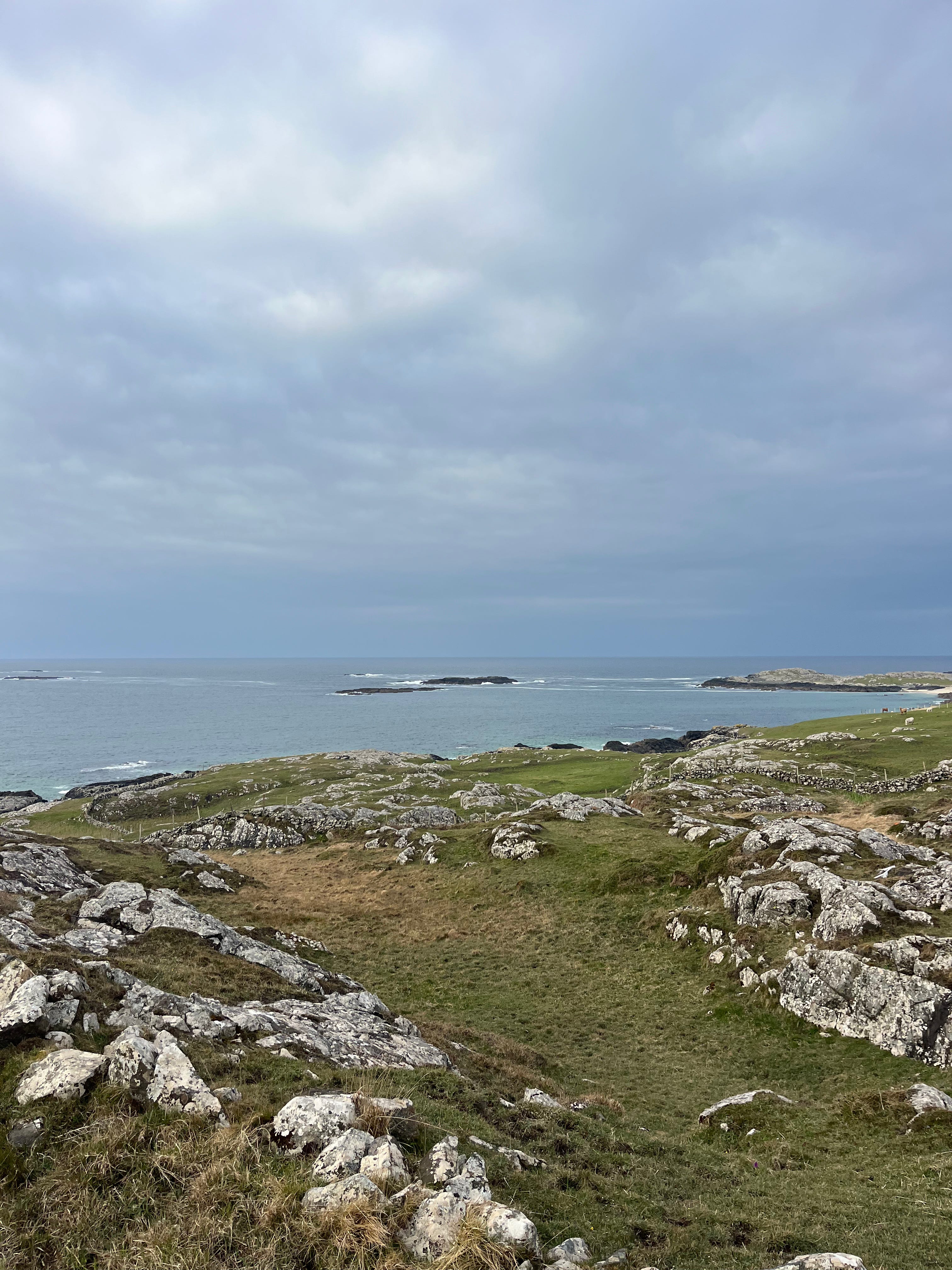
The next day and the next day and the next, we pack picnics and venture into a realm of soft fascinations. The cerulean waters of Mannin Bay, Connemara Bay, Dog’s Bay, and Gurteen. Beaches of coralline algae. Rampant, vivid, blistering gorse. Fog coming down like a gown from summit to valley. A brief suspension of vanity in my own heart. Sea thrift, mountain everlasting, rock stonecrop, St. Patrick’s cabbage, wild garlic. A half-collapsed castle on a hill. Monastic settlements in ruin. Basking sharks circling, fins up. Flocks of sheep spray-painted neon pink, neon blue. Bow-legged lambs. A hint of a sliver of a possibility that all my resentments will die before I do. It’s all real.
I begin Crime and Punishment in bed, I stay up too late with it. The following afternoon, after my son and I witness horses and their riders moving in formation through shallow dunes, I sit on the house’s slate patio with a glass of water and a cup of espresso. It is quiet but for the shush of the washing machine inside and the shush of the waves on the far side of the cliffs. A strangeness takes shape between this safety and Raskolnikov’s world of abjection and madness, which is our world, too. “Suffering,” Dostoyevsky wrote, “is the sole cause of consciousness.” There is no amount of rationalizing or historicizing that will lend a just and final order to the mess we’ve made.
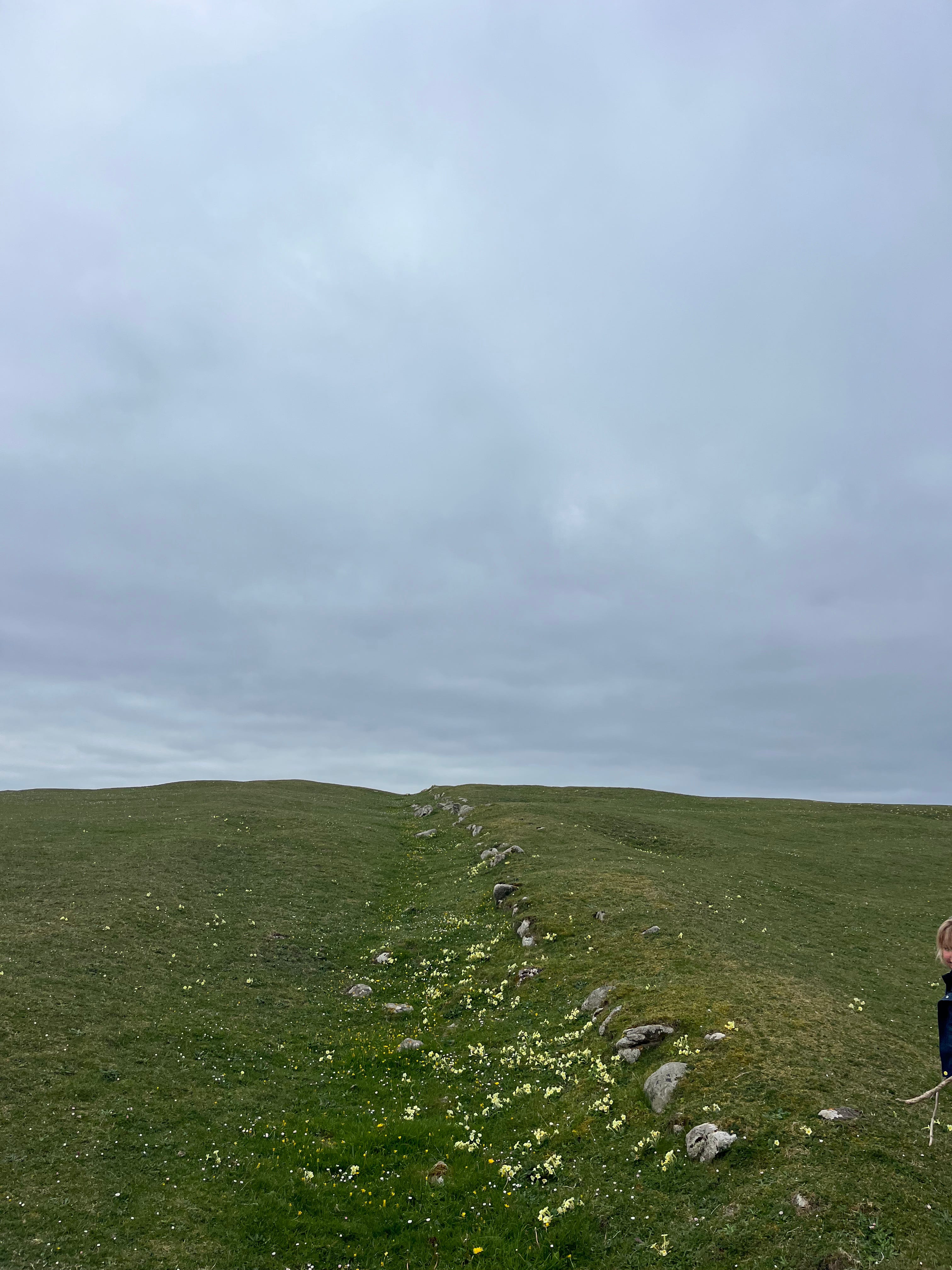
On our last evening in the west we ramble along the property line set by an old stone wall. We see a flock of whimbrels, and enormous hares galloping into the sunset. In the morning, through the big north-facing windows, I watch as the marine layer parts to reveal mountains, an eternity. As we begin packing the car we notice that a number of snails have appeared in the grass near the front door. We are very careful to harm not a one.
My husband drives absolutely perfectly from one end of the country to the other, back east to my beautiful mother in her tumbledown castle. In preparation for our return she has filled several bowls with lemons, apples, clementines, kiwis, bananas, mango, and melon. Eggs and salad greens and small wheels of cheese in the refrigerator, fresh bread and butter on the countertop, vegetable lentil soup in the crockpot. My mother was born generous or the vicissitudes of existence have made her that way. She gives the minutes of her life, all she has, to others. I don’t praise her enough, I never have, but if there is anything worth praising, it is this, and if there is anyone worth praising, it is her.
After dinner we drink lemongrass and ginger tea with honey. A fox slinks over the field just beyond the ha-ha, and the moon is nearly full, ascending slowly to sit heavy as a guru in the firmament. In our time we are so interested in knowing our sorrow, in claiming our anger and our disappointment, that we risk ignoring our own happiness.
My bedside light is a salt lamp, pink and dim enough not to disturb my dreaming son and bright enough to see the words: Environment is everything, and man himself is nothing. I read Raskolnikov as a cipher, understood by no one, least of all himself. What is meaning in the absence of rationality? I write in the margin. Is freedom/free will more or less possible in a world interpreted through faith or through technology and science? I close the book and turn off the light, I lie still in the dark.
Reading Recommendation: A Time to Keep Silence by Patrick Leigh Fermor
♥️